Building with Action Cards
Generally in a turn-based game, your turn is your turn. You make your plays, you draw your cards and play them as you see fit, you move your chess pieces , and you respond to the game board. With some games there is very little room for interactivity during your opponent's turn. But with that in mind, games are far more complex and have more interesting layers when cards can be played universally - like when your opponent is making their moves.
Action Cards make up a good portion of the launch set for QFTCG. Each card has a purpose. Draw you more cards, deal damage to Players and their Player Cards on the field, search out your deck or discard for resources, and disrupt your opponent when they make powerful moves. Action Cards can be played, as the rules state, at ANY time during game play. Provided you have the necessary Energy required to turn and make your play, Action Cards will make up a good part of the game when they make up a good part of your deck.


Action Cards don't have specific types, but there is a wide range of utility for them. These two cards specifically search out cards from your deck and place them in your hand. Cards like these do not resolve until the entire action from the card is completed. This is what is known as a "stack of plays" when multiple Action Cards come into play and must resolve. All Action Cards, after their text in play resolves, are discarded afterwards (unless text states otherwise).


Cards that specifically read after another Player uses an Action card do just that; they trigger when you pay the cost and meet the conditions of the card, effectively challenging another card coming into play. These cards disrupt actions and create a stack of cards until all cards are resolved. Players can continue to counter other counter cards if it can be done with the remaining Energy.
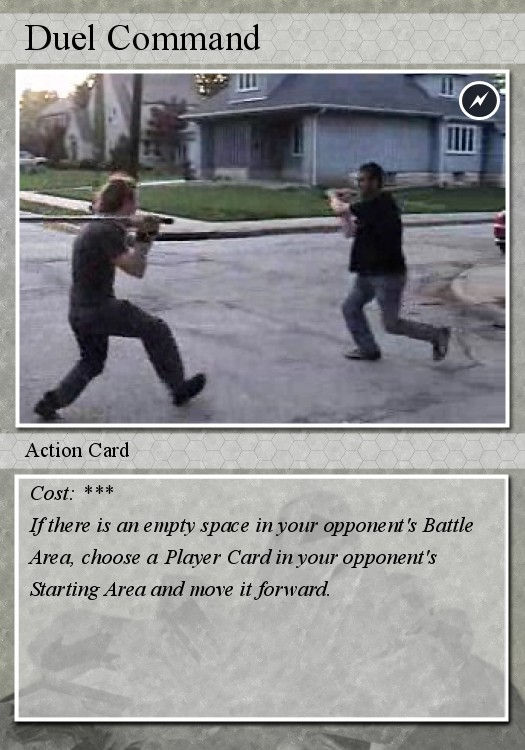

Many Actions also play into breaking the rules of game play and performing certain game mechanics out of turn or against the usual order. Moving an opponent's card forward is something only an Ability or Action Card may supersede as far as rulings. It's why it is important to note that any card text that breaks a rule takes precedence. Duel Command forces your opponent to move something forward, even if it is a New Recruit. Rivals creates a disruptive and sometimes advantageous new hand for both players.
Building a deck that centers around the right counters that also compliment the cards you are attacking and defending with matters. A deck that focuses on what you want to do with your main attackers means you can easily choose which actions fit best.

Building around a main attacker like "Leon, Leader of the Defenders" means picking the right Action Cards and putting in plenty of Gemstones and Player Card support. Check the list below:
Player Cards/Transform Cards
4 Leon, Leader of the Defenders
4 Liz, the Painter
2 Heather
2 David, Forest Scout
2 Swordsman
1 Armor of Light
1 Armor of Brotherhood
Action Cards
4 Spoils
2 Counter Action
2 Gathering
2 Preparation
2 Defenders, Move In
2 Duel Command
Gemstones
4 Attack Up
4 Stand and Fight
2 Flash Strike
1 Restoration Blade
1 Steel-Bolt Crossbow
Comments