The Rules and Design of a "BASE SET"
If you have ever played a trading card game, you have likely run into and are familiar with the big community driven card game: MTG, Magic The Gathering. It gets its own night of the week in FNM (Friday Night Magic). It's over 20 years old now, with multiple formats to fit players' taste in game play (Standard 60-card decks, multiplayer format Commander, etc.) and tons of valuable cards. It has spurred multiple novels and graphic novels, it has an expansive universe of lore, and it now has its own digital version of the game along with countless tools made to make tracking life and tokens much easier. No other card game has its following worldwide.
Pokemon - a personal favorite of mine - comes close due to the sheer phenomenon driven commercialism about its entire franchise. Yu-Gi-Oh also has its niche. Many other card games don't come near as close however; A Game of Thrones, Dragonball Z CG, Force of Will, Netrunner, and many others that fill that variant of "it's not quite like Magic."
Quincy Fighters is also "not quite like Magic" but it borrows from the best mechanics. It has Energy Cards instead of Mana, and you turn these cards in your Energy Pool to recruit and summon cards to the Field. There's a Starting Area (where Player Cards begin in play) and a Battle Area (where PC's deal damage to the opposition). Defeating your opponent's cards earns you Ranks instead of depleting an enemy's life total; fighting your opponent "unopposed" earns you Ranks as well because they aren't putting up a fight to your fighters! There are Action Cards instead of Instants; there are Gemstones which are not the same as Sorcery cards or Equipment. Your Battlers can only attack after they have advanced forward to this Battle Area; not everything can swing for damage at once, so there is a bit of slower pacing and planning to your moves.
There are many "Magic" tropes in this game. But it is far and away from its inspirations.
In many ways this is a fan game paying homage to other card games, but it doesn't get weighed down by the restriction of being just another fan-made card set adhering to the rules of another game. Countless fan creations are made for other similar card games. Sure, they can have unrealistic stats that are overpowered and seemingly game breaking. But when a card is made to be unrealistic in a game universe where there are many established norms, it fails to see any playable value. I personally enjoy a well-thought fan creation that has a solid idea behind it that has synergy with other cards that exist.
But why hold yourself to just a fan creation? Why not make it your own and put your own unique spin on it?

Quincy Fighters has a simple objective: become a Rank 10 Commander of your forces. You begin the game at Rank 1. You earn Rank Points through several means. Your Player Cards fight for you, and they fight other Player Cards. Defeating Player Cards earns you points. Dominating the Battle Area against no opposition earns you points. Playing certain cards at the right time earns you points. If your opponent doesn't keep an opposition or find ways to counter you, you're on your way to victory.
Player Cards tend to attack what is in front of them, and they have two ways of doing so: Base Attack damage and Special Attack damage. A Base Attack costs nothing; it is a free swing at your opposition. Special Attacks cost Energy, which you will need to play all your cards. Energy is turned to recruit new Player Cards, summon Gemstones, and play Action Cards. Much like other similar Mana pool based games, you are allowed one Energy play per turn.
Not all Player Cards fight at once, however. If they did, it would be a chaotic rumble in the streets of Quincy where no one can tell who wins. So the Battle Area is limited to two spots for Player Cards on each side. Two versus two. When "New Recruits" come into play, they enter in the Starting Area (for the most part). Here, there is no limit. Prepare your forces for days. There's no limit to how many cards you can play, so long as you can afford it. But you can only move forward and retreat ONE Player Card each during your turn.
The game has a slow pace to its beginning, but it demands players to continue thinking forward; if you don't send your recruits forward you begin to suffer for such. The Game wants you to battle for your claim to the land. Because once you slow down, your opponent will keep on moving forward and take it from you. This is intentional in design; a game that goes nowhere or extends for unnecessary amounts of time was THE aspect that needed removed from the get-go.

Outside of your fighting forces, as a Commander you have a few other elements to help you. One major part of your deck will be Action Cards. These are cards that can be played at ANY TIME. At the start of your turn, during your opponent's turn, during the Battle Step, right before your turn ends, etc. They are the most game-changing elements in the game because they are universal. Typically, they might make up a quarter of your deck.


Gemstones are another element thrown into the mix. They equip automatically when they are played, and Player Cards can have one Gemstone of each type attached to them. In the Base Set there are two types: Weapon and Gemstone. Weapons provide additional Special Attacks, whereas Boosts provide better attack or HP stats. These can be played during your turn, before you declare attacks in the Battle Step. And these cards are great at turning otherwise simpler, more basic cards into competent fighters.
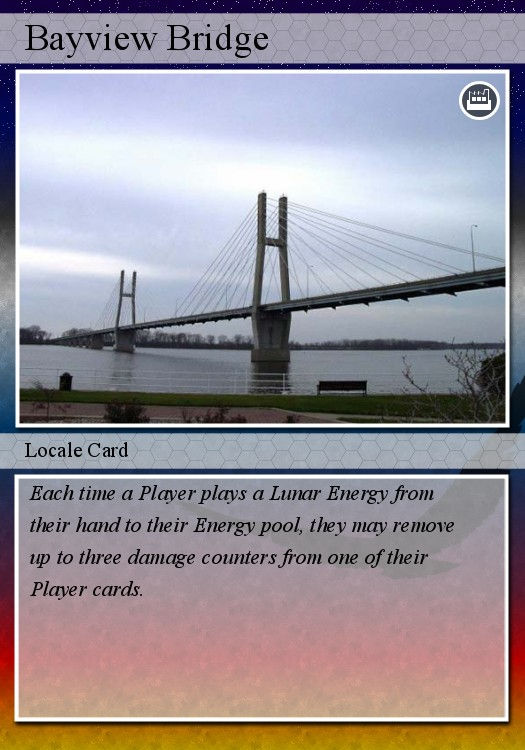
Finally, we have Locale Cards which change the conditions on the Field. All Players can take advantage of their effects when they come into play but they are typically card geared toward a particular card type or color. As of now, they are of niche use for decks.
Players begin the game with a hand of seven cards (with a free mulligan if they wish to use it) and can have no more than seven cards at the end of their turn. Each turn begins with returning Energy to its Balance form and drawing a card, and each turn ends with the Battle Step, declaring attacks on all Player Cards in the Battle Area.
Them's the basics.
In its current state, there are 96 cards in the Base Set of Quincy Fighters, with a variety of Player Cards and Action Cards making up the bulk. As the game is continually tested, we see prevalent strategies from particular cards leading the charge in decks. Because cards have different ways of attacking (free Base Attacks, costly Special Attacks, Ranged damage), each deck tends to focus on using those attacks to their greatest strength. There are fast aggressive decks. There are slower, more methodical decks that build high damage late game. There are decks that focus on tanking and healing, wearing down the opponent's forces. There is a deck that tries to hard counter everything with simple counter actions and discard effects. Some decks are OK. Some are way more than OK.
All these decks lead to figuring out how much cards need balanced. One play through at a local area convention showed just how far ahead the "Pro TCG Player" card's original printed power could put a player ahead. More sessions showed just how broken certain effects were when stacked upon one another and left unchecked or unable to be countered.
In Beta, it's hard to say whether a particular card is broken or not when it is still in its infancy. Instead, cards need played over and over again to establish what will inevitably be a "meta" for a new card game. Lots of newborn CG's have an interesting beginning. Just look at the revamped new Dragonball Z CG for the some of the most recent evidence. Immediately following its first expansion's release, cards' text had to be "retconned" for the purposes of avoiding confusion with in-game effects. Its nearly a two-year old game and it's still growing strong in the DBZ community (and really in the CG community in general). New games and their developers have to work under the pretense of knowing things like that may have to change quickly to keep a game alive and fresh to players (it's a shame that's the reason so many new CG's are switching to strictly digital format - looking at you Hearthstone!)
It's also hard to say whether this game should be digital or printed, or both! A digital platform would be great for testing, but there's more to a card game you can physically feel in your hand. On the flip side, cost for a game such as this can be a bit of a head-scratcher. How does one market a game such as Quincy Fighters? "Where the hell is Quincy, and who are these people on these cards?" "How does a Pro TCG Player exactly pull off a Mach Punch?!" Clearly, the game is made for a very select audience: the friends of those who are in it.
But maybe not. Maybe this game, made by card players for card players, is exactly what it needs to be: an ironic representation of the ridiculous premise of monsters and warriors and hellspawn fighting each other... on a table in card stock form. The narrative of the game is just that: "Lords of Underdark" who can't agree on the greatest card game so they instead decide to drink large amounts of Energy Drink and throw down in the streets of their Midwest River City to see who is truly the best, like no one ever was.
Part of the appeal is just that alone. More so is that the game has multiple layers of strategy to it. It's not a fan-version of another game. It's a game trying to be its own, with its own identity represented by the Players pictured and battling within it.
Comments